
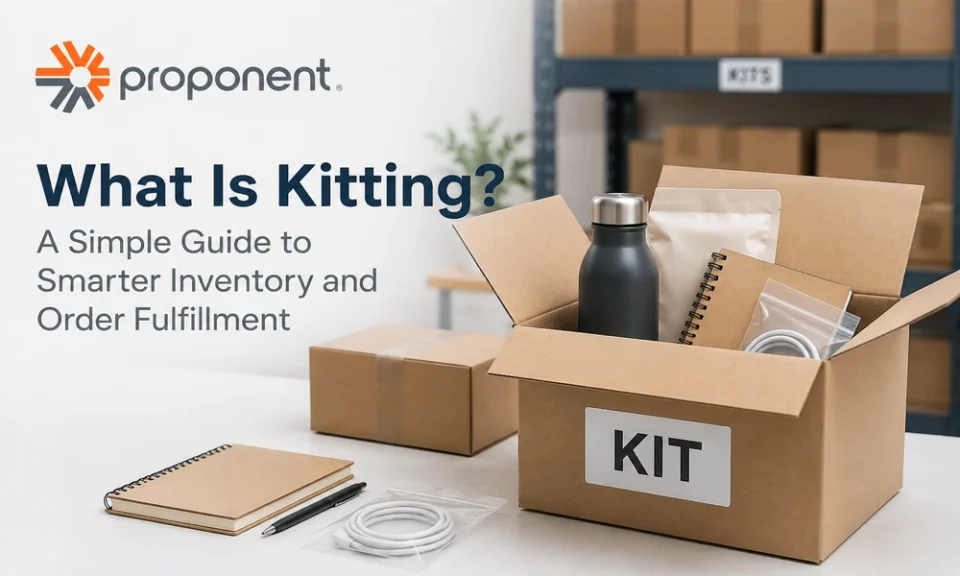
If you have ever asked, what is kitting, the main response is as clear as a day. Kitting means taking individual products or parts and assembling them together to create one ready-to-use entity. Rather than having to individually select each item out every time an order is placed, businesses bundle these prepped items together in advance. This results in saving time, better accuracy, and speeding up the order fulfillment process.
As kitting saves valuable efficiency in the manufacturing, warehousing, eCommerce, healthcare, and retail industries it is one of the jobs that use it.
How Does Kitting Work?
With that in mind, we can learn what is kitting. Let’s say for example, a company that sells a home office starter pack. Rather than holding a chair, keyboard, mouse, and desk lamp as one product stored separately until they are combined in one kit.
The kitting process usually includes:
- Selecting the required items
- Inspecting each product for quality
- Packing everything into one package
- Labeling the completed kit
- Storage or shipping of the completed bundle
Once assembled, that kit can be ordered and shipped as one product.
Where is Kitting Commonly Used?
Kitting strategies depends on various industries to improve each of their operations.
Common examples include:
- eCommerce gift bundles
- Manufacturing assembly kits
- Medical and surgical supply kits
- Subscription boxes
- Promotional product packages
- Electronics accessory bundles
Having prepped kits makes it faster for businesses to respond when a customer submits their order.
Benefits of Kitting
There are many benefits of kitting, both for businesses, as well as customers.
Few most important advantages include:
- Faster order processing
- Fewer picking and packing errors
- Better inventory organization
- Lower labor costs
- Improved customer satisfaction
- Easier stock management
This is how kitting works and all these benefits make it an important concept for companies who want to streamline their warehouse operations further.
Kitting vs. Assembly
Assembly is a different process from kitting, which some confuse it for.
Kitting groups items into a single package but does not alter the products involved. Assembly means assembling parts to form the complete product. Kitting, for instance, is putting screws and bolts and instructions into a box. Assembly is when you use those pieces to build a chair.
Knowing how they differ from each other helps the business in determining what process is right for them.
You are Not Kitting Ready for Every Business
Not every company needs kitting. Its suitable for businesses that need to sell a company pattern of small items together frequently or use multiple components in production. Alongside these changes, businesses must assess storage space, inventory management systems, and consumer demand before implementing a kitting process.
In the right conditions, kitting can streamline your workflow without compounding complexity.
Final Thoughts
In order to be cognizant of what exactly is kitting, businesses have to understand how simple changes can make the operations in the supply chain more efficient. The logistics benefits of grouping related products into easily-shippable packages enable companies to save time, decrease error rates, and process orders more efficiently. Kitting is an effective strategy to help with productivity, while giving your customer a better experience whether you have an online store, warehouse, or production floor.
