
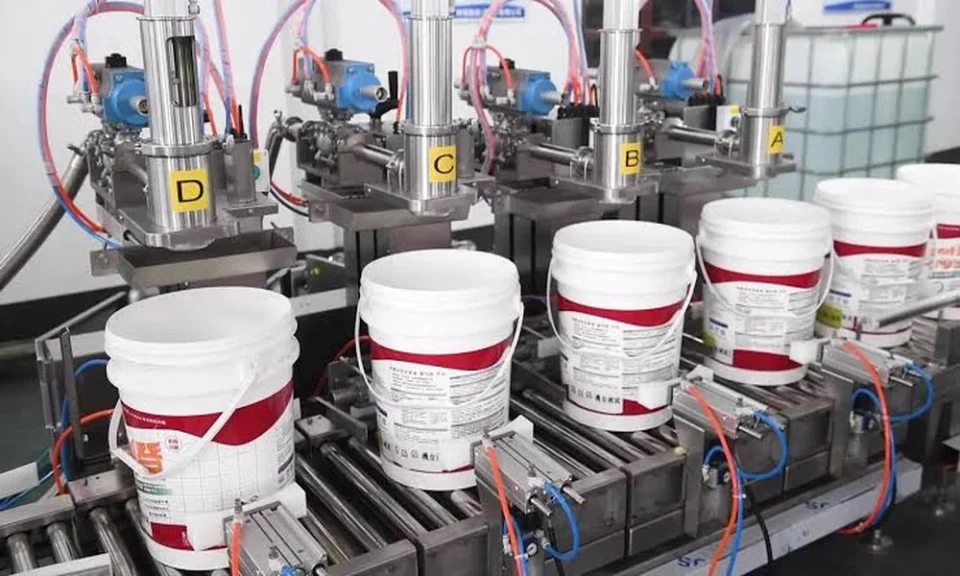
Pails sit in an awkward middle ground for many production teams: too large and heavy to fill comfortably by hand at volume, yet often treated as a lower priority for automation than smaller retail containers. That assumption costs more than it looks like on paper, since manual pail filling is slow, physically demanding and difficult to keep consistent across a full shift once fatigue sets in.
Why Pails Are Harder to Fill Consistently by Hand
A 20-litre pail full of product is heavy enough that manoeuvring it under a hose or nozzle introduces spillage risk and fill-level variation that smaller containers rarely present. Workers naturally adjust their pace as a shift wears on, and that fatigue shows up directly in inconsistent fill weights by the end of a long run. Supervisors who compare morning and afternoon fill samples often find a measurable drift that has nothing to do with the product itself and everything to do with operator fatigue.
How Automated Filling Changes the Process
An automated pail filler positions the nozzle precisely, meters product by volume or weight, and releases a consistent dose regardless of how many cycles have already run that day. Because the mechanism does not tire, the hundredth pail filled is just as accurate as the first, which is difficult to guarantee with manual pouring. The consistency also makes downstream quality checks simpler, since inspectors are looking for genuine faults rather than the routine variation manual filling introduces.
Speed Gains Across a Full Shift
Where a worker might comfortably fill a modest number of pails per hour by hand, an automated station sustains a materially higher rate without needing rest breaks that interrupt output. Multiplied across an eight-hour shift, that gap in sustained throughput becomes the difference between meeting a daily order and falling short of it. Production planners who model capacity around manual filling rates often discover they have significant headroom once the process is automated.
Reducing Product Waste and Spillage
Manual pouring almost always sacrifices some product to drips, splashes and overfilling used as a buffer against underfilling complaints. A controlled dosing mechanism eliminates most of that margin, and for higher-value liquids or chemicals, the product saved over a year can offset a meaningful share of the equipment cost on its own. Reduced spillage also means less time spent on floor cleanup and less waste product requiring disposal, which carries its own cost in regulated industries.
Improving Fill Accuracy for Regulated Products
Chemicals, food ingredients and industrial fluids sold by declared volume are subject to fill-accuracy expectations that manual pouring struggles to meet consistently across a large batch. A volumetric pail filling station holds tolerances tight enough to satisfy these requirements without relying on an operator’s judgement call on each pail. Consistent documentation of fill accuracy also simplifies customer audits, since the figures come from the machine’s own logs rather than manual records compiled after the fact.
Reducing Physical Strain on Workers
Repeatedly lifting, tilting and manoeuvring heavy pails under a hose is a known contributor to manual handling injuries in production environments. Automating the fill step removes that specific physical demand, letting staff focus on positioning, quality checks and packing instead of repetitive heavy lifting. Fewer manual handling injuries also means less disruption from medical leave and lower workers’ compensation exposure over time.
Integrating Filling With Capping and Labelling
Once filling is automated, it becomes far easier to synchronise with downstream capping and labelling stations, since the pace of pails leaving the filler becomes predictable rather than dependent on how quickly a worker moves. This predictability is often where the bigger efficiency gain actually shows up, beyond the filling step alone. A predictable feed rate also reduces the buffer stock needed between stations, freeing up floor space that would otherwise sit idle.
Cleaning and Product Changeovers
Switching between products on an automated pail filler generally means a defined cleaning and purge cycle rather than an improvised wash-down, which reduces cross-contamination risk and shortens changeover time once the procedure is established. This matters most for facilities running several formulations through the same line. Documenting the purge cycle also makes it far easier to train new operators consistently, rather than relying on informal habits passed between shifts. A written checklist for each product changeover further reduces the risk of a step being missed when a less experienced operator has to run it alone.
Calculating the Efficiency Gain for Your Line
The clearest comparison is pails filled per labour hour before and after automation, combined with the reject rate for under or overfilled containers. Facilities that track both figures usually find the labour saving alone justifies the investment well before factoring in the reduction in product waste. Reviewing both metrics together over a full quarter, rather than a single week, gives a more reliable picture once seasonal demand swings are accounted for.
Deciding When to Automate Pail Filling
Operations filling more than a modest volume of pails per day generally reach payback fastest, while lower-volume or highly variable runs should weigh the investment against flexibility needs. Once volume justifies the switch, moving to automated pail filling tends to deliver returns through fewer injuries and less waste as much as through raw speed.
